
7 Proven Ways to Write a Strong Federal Employee Self-Assessment
Your self-assessment may be your best chance to influence the rating you receive. Local 17 President Doug Massey walks through how to write one that makes the case for the rating you earned.
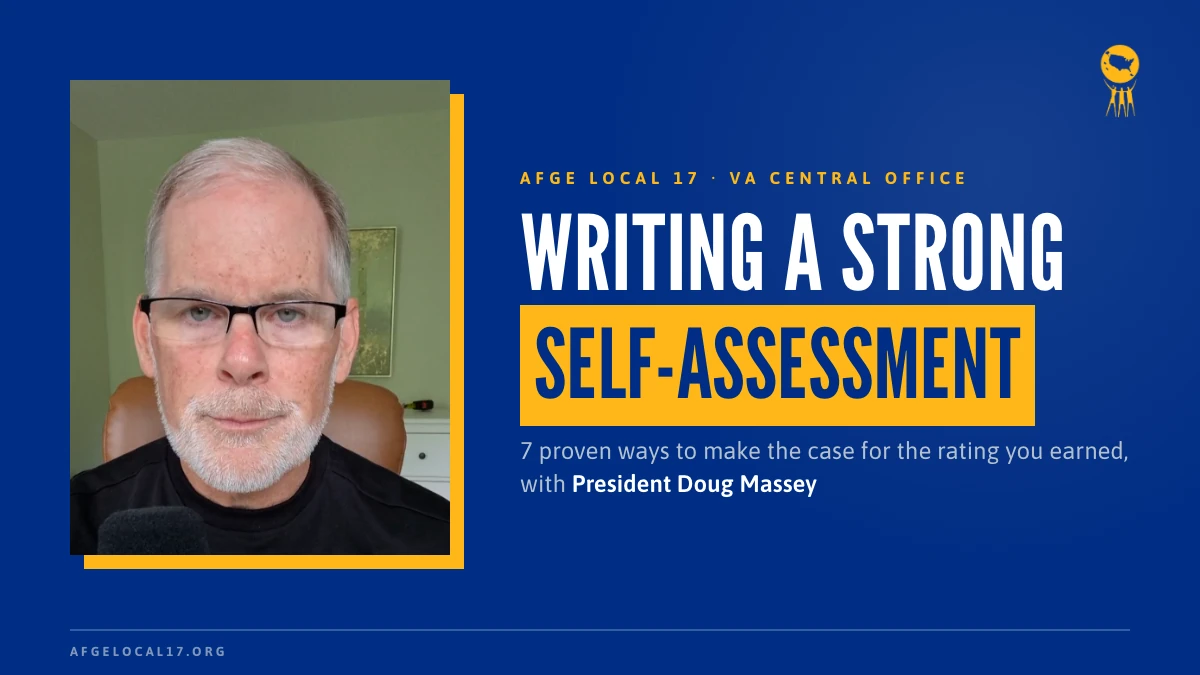
Performance review season is here again, and with it comes the part most people put off until the last afternoon: the self-assessment. A lot of employees treat it as routine paperwork. Fill it in, hit submit, move on.
Don’t. Your federal employee self-assessment may be the single best opportunity you have to influence the rating you receive. Your supervisor does not see everything you do. They don’t necessarily know every problem you solved, every coworker you helped, or every obstacle you worked around this year. The self-assessment is where you put those things into the record.
AFGE Local 17 President Doug Massey walks through how to do that in a new video, and the advice below follows it. Watch it here:
The Master Agreement calls your self-assessment “a critical source of employee performance information” and says employee input is “essential to the appraisal process.” That language is there for a reason. Use it.
1. Start your federal employee self-assessment with the performance plan
Open your performance plan before you write a word. Every element in it gets its own answer, whether or not you think it matters. Skipping one leaves an exceptional criterion unanswered, and an unanswered criterion is a rating decision you have handed to someone else.
For Board attorneys, the FY 2026 plan has five elements: productivity, quality, case management, customer service, and information security. The first four are critical; information security is not. Every one of them still belongs in your write-up, for reasons the rating math below makes clear.
2. Write to the exceptional standard, requirement by requirement
Here is the basic approach for each element of a federal employee self-assessment. Read the exceptional standard. Take it apart requirement by requirement. Then show how your work meets each one, using the language of the standard itself.
If exceptional requires A, B, and C, explain what you did during the year that demonstrates A, B, and C. Don’t make your supervisor figure out the connection between your work and the standard. You make the connection for them.
3. Show them the evidence, not your duties
“I process cases throughout the year” tells a rating official what your job is. It says nothing about how well you did it.
Whenever possible, show them the numbers. The productivity standards already count some of them; the rest are yours to supply:
- How many cases did you complete?
- How many people did you serve or train?
- Did you reduce a backlog or improve timeliness?
- Did you save money, or finish a project ahead of schedule? By how much?
If something was a team accomplishment, explain what you personally contributed. Don’t take credit for somebody else’s work, but don’t be so modest that your contribution disappears from the record.
4. Make invisible work visible
Ask yourself one question: what did I do this year that mattered, but my rating official may not know about?
Coworkers regularly come to you for help. Maybe you informally mentor someone, or you built a resource people now rely on. Maybe you solved a recurring problem or took on extra work when a colleague was out. If it relates to your performance standards, it belongs in your federal employee self-assessment.
Customer service is a good example. For Board attorneys it is a critical element, and its exceptional standard talks about regularly going above and beyond, including “activities that promote the development of others.” Do other attorneys bring you difficult legal questions? Do you share research, provide training, or help someone work through a hard case? The Board counts your decisions and tracks your untimely cases. Nobody necessarily counts the twenty minutes a day you spend helping a new attorney understand a difficult issue. Yet that work may directly support an exceptional rating under customer service. Your judge may have no idea you are doing it unless you say so.
Why every element in the plan matters
This is the part of the rating math worth memorizing.
If you are rated less than fully successful on even one critical element, your overall rating is unsatisfactory. That is serious: it means a performance improvement plan, which is the first step toward removing an employee for performance.
The non-critical elements matter at the other end of the scale. Under the performance appraisal regulations and the plan, to receive an overall outstanding rating every element, critical and non-critical alike, must be exceptional. A Board attorney who is exceptional in all four critical elements but only fully successful in information security ends the year rated excellent, not outstanding.
5. Don’t skip the simple elements
Information security is a case in point. Its exceptional standard is remarkably simple: there are no deficiencies.
So if you had no deficiencies, don’t assume your judge will make that case for you. Say it. “I had no information security deficiencies during the rating period.” That’s it. Sometimes a strong federal employee self-assessment isn’t complicated. It is making sure you leave nothing unanswered.
6. Explain the factors beyond your control
What if the numbers don’t tell the whole story? Maybe you missed a target because of computer system problems (everyone at the Board knows about case flow). Maybe management didn’t provide enough work. Maybe you were waiting on another office, or your resources were cut, or your assignments changed midyear.
Whatever it is, explain it. Article 27 of the Master Agreement says that when evaluating performance, employees will not be held accountable for factors beyond their control.
Don’t make excuses. Provide facts. Say what happened, explain what was outside your control, and describe what you did to mitigate it. Don’t let a number standing by itself tell an incomplete story about your work.
7. Answer three questions for every accomplishment
Connect your accomplishments to results. For each one, ask:
- What did I do?
- What was the result?
- Why did it matter?
Did your work help a veteran? Improve accuracy? Reduce a backlog, or save time or money? Answering those questions is what turns a list of activities into a persuasive federal employee self-assessment.
After you get your rating: deadlines and the signature question
A strong federal employee self-assessment is the first half of the process. The second half starts when the rating arrives, so watch the deadlines. Under Article 27, VA must issue your written annual appraisal within 60 calendar days after the end of the appraisal period. If you disagree with the rating, don’t sit on it. Under the negotiated grievance procedure, a grievance generally must be filed within 30 calendar days of when you became aware, or should have become aware, of the action you intend to challenge.
Doug gets one question more than any other: should I sign my performance appraisal if I disagree with it?
Yes. Signing acknowledges that you received the appraisal. It does not mean you agree with the rating, and it does not prevent you from challenging it later. Sign it, keep a copy, and make sure you know the date you received it. If you believe your rating is wrong, contact Local 17 promptly.
The place to be accurate
Your self-assessment isn’t the place to be modest. It is the place to be accurate: to build a record, and to make the strongest factual case you can for the rating you earned.
Start with your performance plan. Address every element. Read the exceptional criteria and show how you met them. Use facts and numbers, include the valuable work your supervisor may not know about, and when something outside your control affected your performance, explain it. A federal employee self-assessment written that way does its job.
If this was helpful, follow Local 17, leave a comment on the video, and tell us what other workplace issues you would like us to cover. And to our dues-paying members: thank you for your support.